|
NEWS |
The Special Needs Trust Company:
A Non-profit Trust Company for Children with Special Needs
Lawyers take note: you have a new way of giving back to society! The non-profit
Special Needs Trust Company ("SNTC") was formed earlier this year
to provide low-cost trust management services to special needs persons who
are unable to manage their own affairs. The goal is to help settlors plan
financially for the time when they will no longer be able to take care of
their special needs dependants. Due to the legal knowledge required to understand
trusts, this is a community service project to which lawyers can especially
contribute.
Who is a Special Needs Person
SNTC defines "Persons with Special Needs" as:
... those whose prospects of securing, retaining
places and advancing in education and training institutions, employment and
recreation as equal members of the community are substantially reduced as
a result of physical, sensory, intellectual and/or developmental impairments.
This may also include person with mental disabilities.
The Importance of SNTC
Due to the fact that special needs persons lack
the capacity to manage their own finances, money cannot be bequeathed to them
directly, and problems will arise if assets devolve to them through intestacy.
Money meant for their care must be managed by someone else. Yet parents and
guardians who want to plan ahead may encounter difficulties: they might not
want to entrust money to subsequent caregivers, and professional trust services
involve prohibitive fees and large principal sums (typically at least S$1
million). In contrast, SNTC only requires S$5000 from settlors to get started,
and its fees are more affordable.
Brief History of SNTC
As early as 2004, the demand for an affordable
trust scheme was apparent - some of SNTC's pioneers were already involved
in welfare organisations such as the Movement for the Intellectually Disabled
of Singapore ("MINDS") and they received public feedback through
their work. They approached the National Council of Social Service ("NCSS")
and the Ministry of Community Development, Youth and Sports ("MCYS")
for assistance in implementing the scheme. In order to minimise costs, the
Insolvency and Public Trustee's Office ("Public Trustee") was asked
to help manage the trust funds. Finally, NCSS and MCYS agreed to assume supervisory
roles over SNTC so that the Monetary Authority of Singapore would grant SNTC
an exemption from the licensing regime of the Trust Companies Act. Throughout
the entire process, which included formulating the trust deed, numerous lawyers
from multiple organisations contributed their time and effort.
Features of the SNTC Trust
SNTC is both a registered charity and an Institution of Public Character. Hence, its services are reserved only for those who satisfy its definition of special needs.
Potential settlors will meet with SNTC to discuss the needs of beneficiaries and formulate a care plan, which will take the form of a non-binding letter of intent that may be revised from time to time. The trust is activated once the trust deed is formalised, but the funds will only be disbursed when the settlor dies, becomes incapacitated, or goes incommunicado. SNTC will have discretion to make the necessary disbursements. In doing so, SNTC may consider the settlor's letter of intent but is not bound by it - its overriding concern is to act in the best interests of the beneficiary. Settlors can provide for top-up of the trust account in their wills, or nominate the trust account as the beneficiary of their insurance policies and/or Central Provident Fund accounts.
All SNTC trusts will be irrevocable. This ensures that settlors have completely divested themselves of their interest in the moneys, which prevents revocation of the trust in the event of insolvency or divorce. In addition, a residual beneficiary must be specified in case the beneficiary predeceases the settlor and also to receive any balance in the trust fund on the demise of the beneficiary. The residual beneficiary may be changed if the settlor so wishes.
The trust funds will go into the Public Trustee's
common fund and will be invested in accordance with the Public Trustee Act.
This keeps the trust moneys relatively safe as the common fund is guaranteed
by the government. Interest rates will be relatively favourable. However,
as the Public Trustee only manages cash, settlors will not be able to leave
property on trust with SNTC.
Outreach
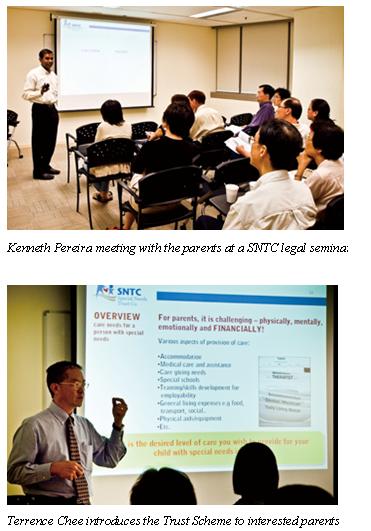
So far, public response towards SNTC has been
very positive. Of the 30 parents who attended SNTC's first round of briefing
sessions, 29 have returned for follow-up appointments. SNTC will subsequently
reach out to more parents through organisations that already have established
networks such as MINDS, the special needs schools and other welfare organisations.
Privately, lawyers can play a part by informing testator-clients of the new
option that SNTC presents.
Pro Bono Lawyers Needed
Prior to signing the trust deed, settlors will meet with pro bono lawyers in small groups to discuss the features of the trust deed. This team of lawyers is currently headed by Mr Alfred Dodwell, partner at Clifford Law LLP.
At present, SNTC needs more lawyers to help in this area. Lawyers do not have to be specialists in trust law; only a basic understanding of trusts is required. The main task is to explain the concept of a trust to lay people, especially the point that settlors will have no control over the trust moneys. No more than three hours once a month should be required from volunteers, and it would be ideal if lawyers can volunteer for at least a year. Interested parties may e-mail Esther Tan at [email protected] or Dr Tang Hang Wu at [email protected] to find out more.
Li Fangyi
Shawn Ting*
* The authors are final year LLB students at
the National University of Singapore