
The Honorable Attorney-General V K Rajah, Judges and Judicial Commissioners, President of the Law Society Mr Thio Shen Yi, distinguished guests, friends and colleagues.
Thank you Mr President and members of your Council for this Award. The C C Tan Award was inaugurated in 2003 during my term as President of the Law Society. We recognised the legacy that Mr C C Tan had left behind for the legal profession. He was the embodiment of high standards of professionalism – of honesty, fair play and personal integrity. Little did I realise at that time that I might some day be the recipient of the Award. I am honoured and humbled, and am most touched to be given this Award.
As I reflect on my long and very satisfying legal career, I cannot but acknowledge the many people who have helped me along on this journey – those who have opened doors and those who provided guidance for me to stay steady on the course. Without their encouragement and support, especially in my early years, I could not have sailed through the stormy seas that challenge every practitioner who wants to do his or her best for the client.
Foremost among them are three luminaries who I would especially like to pay tribute to tonight.
First – someone who I had known since childhood, and who inspired me to become a lawyer – Professor Ahmad Ibrahim. He was a reserved person, but with tremendous depth of intellect. Professor Ahmad was part of the Singapore delegation together with our late Prime Minister Lee Kuan Yew to the Malaysia talks in London which discussed Singapore’s independence from the British. He was one of the architects of the Constitution of Singapore. In 1963, he was appointed as Singapore’s first Attorney-General.
Channelling his legal expertise in Muslim law, Professor Ahmad produced the landmark Administration of Muslim Law Act in 1968. In his later years, he went to Malaysia where he established the International Islamic University Malaysia.
Professor Ahmad gave me much encouragement to be a lawyer. When I finished my “O” levels, he gave me Glanville William’s book, Learning the Law. He put me on the path of the law. As an undergraduate, I was under his tutorage in Islamic law and read his prolific writings on the subject. He had the noble virtue of hard work that every lawyer should aspire to acquire. I learned a lot from Professor Ahmad.
At the end of my first year as a law undergraduate at the University of Singapore, I had a vacation job which opened a new world for me. I spent my vacation, and all other university vacations in those four years at law school with Malayan Law Journal (“MLJ”). I was enamoured by the personality of the founder of MLJ – Dr Bashir Mallal. He had founded MLJ in 1932. It reported judgments of the Courts in Singapore, Malaysia and Brunei. I helped proof read judgments and write headnotes when I was there.
Dr Mallal was an exceptionally hardworking person with a great sense of humour. He wore a bow tie and smoked the cigar. He always had a ready smile. Distinguished guests such as Judges from Singapore and Malaysia would visit him at his office at 10 Malacca Street. Lunch was brought to the office in a tiffin carrier everyday. I was privileged to meet and eat with them during such lunches.
It was a special privilege for me to be under the mentorship of Dr Mallal. He was a man of great character who enriched my experience of life immensely. I continued to go to his office as a young lawyer – he had many lawyers using his office library – until he passed away in 1972. Dr Mallal left a rich legacy of law reports and other writings like the Mallal’s Digest.
When I graduated, I had the good fortune of being a pupil of an excellent master – Mr Graham Starforth Hill. Mr Hill was then senior partner of Rodyk & Davidson, the law firm in which I went on to spend the next 22 years of my life.
Mr Hill was greatly respected as a practice leader. He acted for the late Mr Lee Kuan Yew whenever he had a defamation action. He excelled in tax matters and built a strong corporate client base for Rodyk.
Mr Hill became President of the Law Society in 1969 – the year when I was admitted to practice. He went on to serve as President until 1972. He said in an interview conducted when Rodyk was publishing its book to celebrate its 150th anniversary:
I have always tried to instill in all the would–be lawyers who had passed through the firm as trainees that integrity is the most important single element in being a good lawyer. It always has been, and always will be. One can always look up the law in a book, but only oneself will know what is meant by honesty and integrity.
Mr Hill’s qualities of hard work and integrity had a great influence on me during my early years as a young lawyer at Rodyk.
I have been fortunate to have people who believe in hard work and integrity guide me in my formative years.
I believe that the experiences in the first few years of a lawyer’s career sets the stage for his or her onward development. Today, we have a young profession – more than half of our members are below 40 years old. Those of us who are senior lawyers have the duty to nurture the young ones, so that they will develop the virtues of hard work, fair play, honesty and personal integrity – virtues which would stand our young lawyers in good stead and enhance the reputation of our legal profession.
Being a woman lawyer, I would like to say this on behalf of all our lawyers who are women. When I entered practice in 1969, it was not easy for ladies to be employed by the established legal firms. As Singapore progressed in the last 50 years, all that has changed. This includes the legal profession. The statistics show that 43 per cent of about 5,000 lawyers in practice in Singapore today are women – a not insignificant number. The statistics are even better in the legal service. I have been reliably informed that 48 per cent of the legal officers are women. Five Judges of the High Court Bench are women.
Singapore could not have progressed so well over the last 50 years without the participation of women in the work-force. However I am concerned with the observation made by our President in his message published in the current issue of the Law Gazette. According to him, more “mid-category” women are not renewing their practising certificates.
In reflecting on this observation, I looked at my own situation and contemplated on what allowed me to be in practice continuously – now for more than 45 years. I could do so because I married an extremely supportive husband. My husband, G Pannir Selvam did not expect me to perform the traditional roles of wife and mother of my two children. We have been married for 45 years. Throughout this time, he has been my go-to person for my work problems – be it in dealing with a difficult client or solving a legal issue. He has the knack of analysing the complex legal issue to its core principles and presenting it simply. Being extremely well read, he would magically come up with the appropriate authority to support a legal proposition. To me, he is an intellectual powerhouse and I respect his decisions.
Selvam has been a strong supporter of my legal career. In the same year when he became a Supreme Court Judge in 1991, I shared with him my plans to set up a boutique corporate law firm. He fully supported my decision. He quoted to me Chairman Mao Tse-Tung’s famous words: “Struggle is Happiness”.
To that he added the words of the French philosopher, Voltaire:
Hard work saves us from three great evils:
Boredom, Vice and Poverty.
I am pleased to say that those words continue to inspire me.
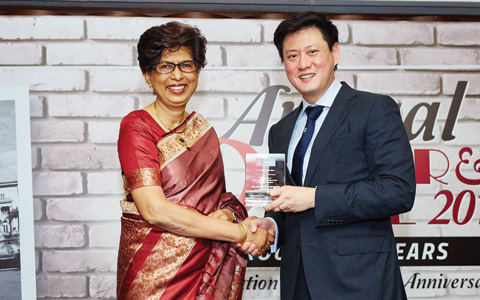
Mrs Arfat Selvam receiving the C C Tan Award from President Mr Thio Shen Yi, SC
To those of you tonight who are husbands, my message to you is “give full support to your wives”. Give her encouragement in whatever she needs to advance herself. The adage “Behind every successful man stands a woman” is true in the reverse too. A woman needs her man to stand by her for her self-realisation.
In closing, I would like to congratulate you, Mr President and your members who were elected recently to Council. You and your Council members have a challenging year ahead. My best wishes go to all of you as you unselfishly give your time for the good of our Law Society members and the larger legal community.