This article reviews recent drug-related cases that touch on wilful blindness and the presumption of knowledge under s 18(2) of the Misuse of Drugs Act. In particular, this article closely examines the question of what is the relationship, if any, between wilful blindness and the presumption of knowledge under s 18(2)? This article then considers what exactly is required to rebut that presumption of knowledge.
A. Introduction
The 2007 Court of Appeal (“SGCA”) case of Tan Kiam Peng v PP1 (“TKP”) is considered by many as the local seminal case on wilful blindness and the presumption of knowledge under s 18(2) of the Misuse of Drugs Act2 (“MDA”). That section provides that “any person who is proved or presumed to have had a controlled drug in his possession shall, until the contrary is proved, be presumed to have known the nature of that drug”. To date, the case provides arguably the most extensive examination of wilful blindness and the presumption of knowledge under s 18(2). Among other things, the SGCA made it very clear that although wilful blindness is treated in law as equivalent to actual knowledge, the threshold to establish wilful blindness is a high one. In particular, the concept is subjective, ie the focus is on what was in an offender’s mind, and an offender must be shown to have been highly suspicious but yet deliberately refused to inquire further; mere negligence or even recklessness is not sufficient to found wilful blindness.3
It has been approximately eight years since TKP was decided. Since then, a number of SGCA and High Court (“SGHC”) cases dealing with s 18(2) of the MDA have made statements that have no doubt caused criminal practitioners and commentators alike concern and discomfort.4 These statements apparently give the impression that wilful blindness has morphed into an objective concept, and that negligence may now be enough to make out wilful blindness, such that the presumption under s 18(2) cannot be rebutted so long as a drug accused has (merely) been negligent. The unease of members of the legal fraternity is natural and understandable. The presumption under s 18(2) is already in conflict with the well-established principle in criminal law that an offender should be presumed innocent until proven guilty.5 TKP’s pronouncements had seemingly made things fairer for the Defence, but subsequent cases appeared to be drawing away from that position.
The author’s main thesis of this article is that once certain misunderstandings and confusion arising from terminology has been cleared up, it will be realised that there has been no backing down of the position taken in TKP. In Part B, it will be argued that the concept of wilful blindness as defined in TKP in fact has and should have nothing to do with rebutting the presumption of knowledge under s 18(2). Part C involves a close analysis of how following recent pronouncements, the Defence can now not only rebut the presumption by showing that an offender did not have the required knowledge, but also by showing that the offender “could not reasonably be expected to have known” (that he possessed the specific drugs he was found with) – specifically, what is the basis for the latter limb, what is to be considered, and how it impacts this area of law. In Part D, we conclude by examining the role of wilful blindness as defined in TKP vis-à-vis drug offences.
This article is principally concerned with the offences of drug trafficking and importation (and exportation),6 where the presumption under s 18(2) is most frequently invoked. There are several other thorny issues that beset this area of law, such as the extent of knowledge required, ie whether the Prosecution only needs to prove that an accused knew that he possessed controlled drug or that he must know the specific nature of the drug that he was found with, and whether the presumption under s 18(2) covered the former or the latter.7 These issues rest outside the scope of this note and will be considered when a future opportunity arises. For present purposes, it will be assumed that for the abovementioned offences: (i) the Prosecution needs to prove beyond reasonable doubt that an accused knew the nature of the drugs that he was found with; and (ii) that the presumption under s 18(2) relates to the same.8
B. Wilful Blindness and Section 18(2) of the MDA
Before moving on, it would be useful to provide a summary of the positions taken in TKP and the cases thereafter that involved drug trafficking or importation offences. In TKP, the SGCA opined that wilful blindness is the legal equivalent of actual knowledge. So where knowledge is a mens rea of an offence, the Prosecution can fulfil the requirement by showing that an offender was wilfully blind, even if he cannot be proven to have actual knowledge. But the SGCA also emphasised that to make out wilful blindness, an offender has to be sufficiently suspicious, and then makes the deliberate decision to not inquire further so as not to confirm his suspicions. Hence, if an offender did not inquire further simply because he was careless, that would only amount to negligence or at most recklessness, but not wilful blindness.9 The SGCA further added that s 18(2) of the MDA encompassed both actual knowledge in its purest form as well as wilful blindness, as it has defined.10 In 2011, the SGCA in Khor Soon Lee v PP11 (“Khor”) reiterated that to prove wilful blindness, there is a “high threshold to be met and a finding of wilful blindness ought not to be made unless there is a strong factual basis for doing so” (emphasis in original).12 Pertinently, shortly after, the SGCA in Nagaenthran a/l K Dharmalingam v PP expounded that wilful blindness is:13
a subjective concept, in that the extent of knowledge in question is the knowledge of the accused and not that which might be postulated of a hypothetical person in the position of the accused (although this last-mentioned point may not be an irrelevant consideration) … . Wilful blindness is not negligence or an inadvertent failure to make inquiries. It refers to the blindness of a person to facts which, in the relevant context, he deliberately refuses to inquire into. Such failure to inquire may sustain an inference of knowledge of the actual or likely existent of the relevant drug (emphasis in original).
That was all good, until a contrary position was seemingly adopted in the SGCA case of Dinesh Pillai a/l K Raja Retnam v PP (“Dinesh”).14 In Dinesh, the Court’s finding of fact was that the accused, despite being suspicious, was careless and negligent in not taking steps which a reasonable person would have to check the package he was transporting to find out what it contained. Thus, the accused was “wilfully blind” and consequently was not able to rebut the presumption of knowledge under s 18(2).15 This was confirmed by the same Court when the accused filed a criminal motion against his conviction.16
This position appears to be completely at odds with TKP, given that the latter case had held that wilful blindness requires a finding that an offender deliberately refused to inquire, and mere negligence is not sufficient. A number of subsequent cases also characterised an offender’s conduct as “wilfully blind” when the Courts held that the respective offenders have failed to rebut the presumption.17 In these cases, the Courts had similarly only found that the offender had failed to make inquiries or take reasonable steps that a reasonable person in the circumstances would have done. This may give the impression that what smacks of constructive knowledge, ie. an offender ought as a reasonable person to have known, is enough to ground a conviction for drug trafficking or importation. This is despite the SGCA in TKP stating explicitly that constructive knowledge “ought to be clearly distinguished from the doctrine of wilful blindness” and that “it is inappropriate to include constructive knowledge as falling within the ambit of s 18(2) of the [MDA]”18 (emphasis added). It did not help that in Khor, the Court conflated wilful blindness and s 18(2) when it held that because the offender had proven on a balance of probabilities that he was not wilfully blind, he had consequently also succeeded in rebutting the presumption of knowledge under s 18(2).19
To exacerbate the confusion, the Dinesh Court additionally held that to rebut the presumption under s 18(2), an offender needs to prove on a balance of probabilities that “he did not know or could not reasonably be expected to have known the nature of the controlled drug” (emphasis added) that he was found with.20 From TKP up until Dinesh, the Courts have only stated that to rebut the presumption, an offender has to prove that he did not know. Curiously as well, the SGCA in Dinesh included the additional way to rebut the presumption without any elaboration or reference to precedents. It was as if that had always been the position in law. Later Courts, such as that in Mohd Ridzuan bin Md Ali v PP,21 acknowledged this change as a “refinement”, but did not explore any further. In light of this “refinement”, coupled with the Courts’ repeated references to wilful blindness in the context of rebutting the presumption under s 18(2), one cannot be faulted for feeling blind-sided; these gave the impression that wilful blindness has become an objective test, and the language of negligence is now involved.
It is submitted that there has simply been a (somewhat major) misunderstanding. The source of confusion is that the SGCA’s exposition on wilful blindness in TKP relates to wilful blindness in the context of proving knowledge from the ground up, where no presumption is involved. And the subsequent Courts’ references to “wilful blindness” (and its associate term “turning a blind eye”) in the context of rebutting the s 18(2) presumption is something similar, but yet conceptually very distinct. In fact, wilful blindness as defined in TKP has remained untouched by pronouncements after TKP, and is wholly separate from what is required to rebut the presumption of knowledge under section 18(2). There are three main reasons for this.
First, there is simply no need to bring wilful blindness as defined in TKP into s 18(2) of the MDA. The doctrine of wilful blindness arose arguably because evidentially, it can be very difficult for the Prosecution22 to prove actual knowledge in its purest form.23 When the requisite set of facts that constitute wilful blindness are present, one can irresistibly infer that the person had actual knowledge, or at the very least, he was legally as culpable as someone who had actual knowledge. But when legislature has already provided a presumption of knowledge, the Prosecution no longer faces any evidentiary difficulty in proving knowledge. Commonsensically, as a provision that presumes knowledge, s 18(2) would presume the strongest and purest kind of knowledge.
Second (and this arises directly from the first reason), to rebut the presumption under s 18(2), an offender has to show that he did not have actual knowledge. The Court in Khor gave the impression that showing that one was not wilfully blind was sufficient.24 But that is not quite logical. When s 18(2) is triggered, how does one know whether it is actual knowledge or wilful blindness that is presumed? It cannot be a chameleon-like presumption that presumes different forms of knowledge in different cases. Assuming it presumes both, and an offender can show that he does not meet the requirements of wilful blindness as defined in TKP, does that mean that he has rebutted the presumption? Mathematically speaking, wilful blindness is a subset of actual knowledge. So proving wilful blindness would also prove actual knowledge. But the inverse is not true. Disproving wilful blindness would not automatically disprove actual knowledge. To be sure, the SGCA in TKP had opined that s 18(2) encompasses actual knowledge and wilful blindness.25 But upon closer reading, it seemed that when discussing the requirements of wilful blindness, the Court was apparently viewing s 18(2) as a provision that prescribes the mens rea element for drug trafficking and importation offences; it was not actually referring to how s 18(2) presumption can be rebutted.26 The distinction is subtle but absolutely critical to understanding what has been going on.
Third, and perhaps most importantly, the requirements of wilful blindness as defined in TKP and “wilful blindness” in the context of an offender not being able to rebut the presumption under s 18(2) are different. The following table outlines the requirements of the two forms of wilful blindness as applied in the various cases:

From the above table, it can clearly be seen that the elements of the two tests are different. Admittedly, there is quite substantial overlap and the differences are not that easy to spot, and this has probably contributed to the confusion. An excellent case for illustration is Dinesh. The Court found that the accused was negligent in not checking further, but there was no finding that he had deliberately refused to do so. Following the test in TKP, the offender would not have been wilfully blind (and he should have been acquitted). But in that case, s 18(2) applied, and so the offender was already presumed to have known that he was carrying diamorphine. The applicable test is that on the right-hand side of the above table. Because the offender was negligent, he failed to rebut the presumption.
In other words, in the majority of the cases following TKP, the Courts were concerned with whether the offender could rebut the s 18(2) presumption. And they were using the term “wilful blindness” not as defined in TKP, but in a crude sense, as a short form for saying that the offender was suspicious that he was carrying something illegal, but did not do what a reasonable person in those circumstances would have done. The clearest evidence that this is so can be found in Dinesh itself, where the SGCA observed that:32
in using the expression “turning a blind eye” in this context, we do not mean to say that the appellant had actual knowledge that the Brown Packet contained diamorphine. In the context of s 18(2) of the MDA, it is not necessary for the Prosecution to prove wilful blindness as a means of proving actual knowledge on the appellant’s part of the nature of the controlled drug in the Brown Packet as the Prosecution has no such burden. Instead, it is for the appellant to prove on a balance of probabilities that he did not know or could not reasonable by expected to have known that the Brown Packet contained diamorphine (emphasis added).
The SGHC in PP v Khartik Jasudass appears to have reconciled the authorities in a similar manner.33
It is further submitted that the difference in requirements between the two tests is justified. In TKP, the SGCA was defining wilful blindness in a situation where the Prosecution needs to prove wilful blindness from the ground up, ie without resort to any presumptions. Thus, the set of circumstances necessary needs to be very strict and the threshold particularly high so as to justify an offender being legally as culpable as someone who had actual knowledge. But where the s 18(2) presumption applies, the law already presumes that the offender had knowledge, and is as culpable as one who had knowledge. If the strict test of wilful blindness as defined in TKP is applied in the context of rebutting the presumption, it would mean that an offender who was careless but who had not deliberately refused to inquire would be able to rebut the presumption and be acquitted. That arguably takes the position too far. The effect of the current position is to encourage one to be as careful as reasonably possible when transporting suspicious items for another.
C. Rebutting the Presumption by Showing that One Could Not Reasonably be Expected to Have Known
So far it has been argued that the test of wilful blindness as defined in TKP has remained entirely intact and has nothing to do with s 18(2) of the MDA. But what about the other source of concern – that in Dinesh the SGCA held that the presumption may be rebutted by showing that the offender did not know or could not reasonably be expected to have known the nature of the controlled drug. Doesn’t this mean that an offender will be found guilty so long he could reasonably be expected to have known the nature? Is the test entirely objective and has the Defence’s burden turned more onerous?
To answer these queries, we first need to examine two fundamental issues – what is the origin of the additional limb, and whether its introduction can be supported? As mentioned above, the limb was introduced in Dinesh without any mention of precedents or elaboration. As far as this author can tell, post-TKP up till Dinesh, the phrase “could not reasonably be expected to have known” was never explicitly used locally in the context of rebutting the s 18(2) presumption. It is noteworthy that in the English decision of Warner v Metropolitan Police Commissioner (“Warner”),34 Lord Reid had observed that:35
So it would be quite sufficient to prove facts from which it could properly be inferred that the accused knew that he had a prohibited drug in his possession. That would not lead to an unreasonable result. In a case like this Parliament, if consulted, might think it right to transfer the onus of proof so that an accused would have to prove that he neither knew nor had any reason to suspect that he had a prohibited drug in his possession (emphasis in original omitted, emphasis added).
The suggestion by Lord Reid was subsequently codified as s 28 of the UK Misuse of Drugs Act 1971,36 which states that:
… in any proceedings for an offence to which this section applies it shall be a defence for the accused to prove that he neither knew of nor suspected nor had reason to suspect the existence of some fact alleged by the prosecution which it is necessary for the prosecution to prove if he is to be convicted of the offence charged.
That provision sounds similar to Dinesh’s pronouncement on how an offender can rebut the s 18(2) presumption. But we may never know whether it was in fact the source of inspiration for the SGCA in Dinesh.
Indeed, there are local cases pre-TKP that, in stating what is required to rebut the s 18(2) presumption, had used similar objective-sounding phrases, such as “there is no reason for suspicion and no right and opportunity of examination”,37 the offender “could not have known” and “could not have reasonably known”.38 The trouble is, these same cases seem to suggest that to rebut the presumption, it is not enough even if the offender can prove that he did not subjectively know. He must also show that objectively a reasonable person could not have suspected or known. That runs contrary to the position in Dinesh, which phrased the additional limb, ie the objective limb, as an alternative way to rebut the presumption.
It is submitted that the Dinesh position should now be the applicable position. For one, it is not entirely clear the pre-TKP cases had actually intended that the presumption can only be rebutted if both the subjective and objective hurdles are crossed. More vitally, in coming to that position, those cases relied predominantly on the House of Lords case of Warner.39 However, the SGCA in TKP had made it very clear that apart from one particular other aspect of Warner,40 “Warner should play little or no part in the Singapore jurisprudence in this particular area of law” because of the different statutory contexts.41 As will be alluded to below, the position taken in the pre-TKP cases goes against the actual language of s 18(2), which must be the first port of call in the local context.
Returning to the Dinesh position, there are two possible ways to justify the existence of the additional way to rebut the s 18(2) presumption. The first is that as a matter of policy, it may be far too harsh if the only way an offender can rebut the presumption is to show on a balance of probabilities that he did not know the nature of the drug. This is considering the Courts have stressed that an offender’s bare assertion of ignorance, without more, will often not be enough to discharge his burden. This prejudices offenders in cases where they genuinely did not know, but through no fault of their own, are unable to find corroborating evidence or generally do not have a believable demeanor. Thus the additional limb acts as an alternative but independent way to rebut the presumption. The main difficulty with this justification is that it goes against the plain reading of s 18(2);42 section 18(2) presumes knowledge until the contrary is proved, and plainly, the “contrary” would be that the offender did not have the knowledge. Section 18(2) does not say “until the contrary is proved or the person proves that he could not reasonably be expected to have known”.43
The second justification, which in this author’s view is the much better justification, is that when an offender can prove on a balance of probabilities that he could not reasonably be expected to have known, that combined with his assertion of ignorance, will be enough to tip the balance in favour of the offender. That is, if an offender can show that a reasonable person in the circumstances would not have done anything else, or that he had done everything a reasonable person would have done, that significantly buttresses the believability of the offender’s account and corroborates his assertion that he did not know. Put simply, what a reasonable person in the offender’s circumstances would have or not have done acts as an evidential proxy for the Court to infer the subjective knowledge or lack thereof of an offender. The assistance of the reasonable person’s perspective may be necessary considering that it is probably as hard to divine an offender’s lack of knowledge as it is the presence of knowledge.44 It is suggested that post-TKP but prior to Dinesh, Courts have, without expressly saying so, already engaged in a similar exercise of using the reasonable person’s perspective as an evidential proxy to assess an offender’s subjective knowledge.45 In this approach, the ultimate effect is that an offender rebuts on a balance of probabilities that he did not subjectively know the nature of the drug. The beauty of this approach is that not only does it ensure that an offender who genuinely did not know has every legitimate chance of proving so on a balance of probabilities, but fidelity to the plain words of s 18(2) is also maintained.
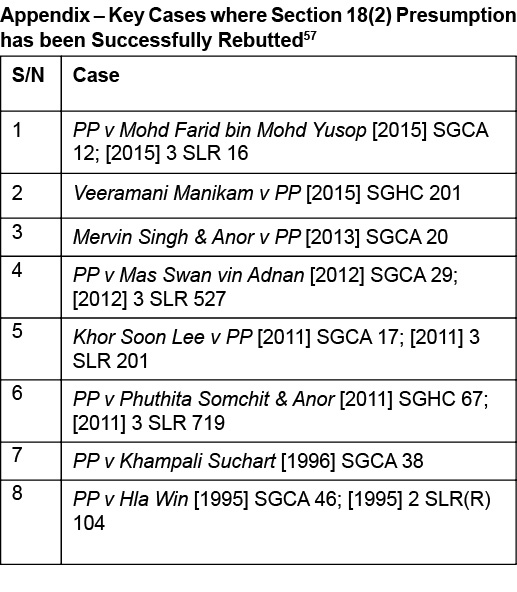
We are now in a better position to tie the threads together. How can one go about rebutting the s 18(2) presumption? For illustration purposes, the Appendix sets out the key cases in the past two decades where offenders have successfully rebutted the presumption. The most direct way is to prove (on a balance of probabilities) that an offender did not subjectively know the nature of the drug he was found with. Examples of this include Khor, PP v Mas Swan bin Adnan,46 Mervin Singh v PP,47 where the Courts found that the offenders had genuinely believed that they possessed something else other than what they have been charged with. As highlighted, the bare assertion of ignorance is often insufficient. The Court will scrutinise a myriad of facts: an offender’s credibility (such as whether the offender’s version of events has been generally consistent throughout his police statements and oral testimony in Court),48 his demeanor in Court, whether there is corroboration from other witnesses or objective evidence, whether the offender’s story is inherently believable or absurd, whether the Prosecution disputes the offender’s story etc. The query is subjective, although if an offender claims to have not known or suspected but a reasonable person in those circumstances would have, the offender may have to satisfy the Court why he did not so suspect. If he fails to do so, the Court is at liberty to infer, after taking everything else into consideration, that the offender did so subjectively know or suspect. But whether there was reason to suspect is only one aspect of the assessment49 (albeit often a crucial one), and the final finding should still relate to the offender’s subjective state of mind.
If the offender is not able to directly prove his lack of knowledge (for example, he is only able to raise a reasonable doubt), he may try to so prove through the indirect way (which has clearly become available since Dinesh) – show (on a balance of probabilities) that he could not reasonably be expected to have known the nature of the controlled drugs. It is suggested that this can be broken down further into three constituent inquires:
Given the circumstances, did the offender subjectively know or suspect at the material time that he was carrying something illegal (or different from what he is now asserting he suspected)?
Would a reasonable person with that state of mind have done anything to confirm his suspicions? If no, it can be said that the offender could not reasonably be expected to have known, and this corroborates his assertion that he did not know (and accordingly the presumption is rebutted).
If the reasonable person would have done something further, did the offender do these? If he had, then similarly he could not reasonably be expected to have known (and accordingly the presumption is rebutted). If he had not, then the offender had been careless, and hence has failed to rebut the presumption. If the offender had taken more than one step to clarify his suspicions, then all the steps should be considered in totality.
An example of the Court applying the indirect method, albeit hypothetically, is PP v Mohd Farid bin Mohd Yusop.50
In considering what a reasonable person would have suspected or done, the Courts have been prepared, and rightly so, to consider the subjective state of mind and characteristics of the offender (eg his gullibility, his state of drunkenness etc).51 The language of the additional limb (he could not reasonably…) supports this approach. Further, in considering what a reasonable person in the offender’s shoes would have done, the Courts have also been prepared to take into account the impracticality or impossibility of taking further steps to check.52
It also cannot be gainsaid that whenever the reasonable person’s perspective is applied, the inquiry is what he would have suspected or done. It is not what he should have suspected or done. The distinction must be maintained. Of course, with the benefit of hindsight, in every case an offender should have suspected that he was carrying something illegal and that he should have taken more steps to check. That would be ideal, but that should not be the test because it would mean that one would practically never be able to rebut the s 18(2) presumption even if he truly did not know.
In cases where the s 18(2) presumption applies, and an offender is not able to prove that he did not know or could not reasonably be expected to have known the nature of the drugs, he may in effect be convicted and punished (often with the death penalty) for simply being careless. This may sound disconcerting, if one’s starting point is the presumption of innocence. But it cannot be underscored enough that in this context, legislature has made it such that the presumption of innocence does not apply with full force because the mens rea requirement of knowledge is already presumed.
Finally, it can be seen from the foregoing discussion that criminal practitioners really have no need to fear at all. The additional limb that Dinesh added has not in any way made the Defence’s job harder, neither has it correspondingly made the Prosecution’s burden any easier. In the first place, even with the additional limb, the Prosecution’s burden remains exactly the same as before. When the s 18(2) presumption applies (which is most of the time in drug trafficking or importation cases), the Prosecution does not have the burden to prove beyond reasonable doubt knowledge on the part of the offender. Knowledge is presumed, and the burden is on the offender to prove to the contrary. To this author’s mind, there are only two ways the Prosecution’s job can be made easier than it currently is: (i) the presumption under s 18(2) becomes an irrebuttable one; or (ii) the offences of drug trafficking and importation are of absolute liability, ie only actus reus and no mens rea requirement. Neither has occurred by dint of Dinesh’s introduction of the additional limb.
In fact, the Defence should take heart because the introduction of the additional limb may in some cases make its job easier. Before Dinesh, the sole way to rebut the presumption is for the offender to prove on a balance of probabilities that he did not know the nature of the drug. That can be an uphill task because the Courts have cautioned that an offender’s bare assertion in the absence of corroborating evidence will often not suffice to rebut the presumption.53 But following Dinesh, even if an offender can only make a bare assertion of his lack of knowledge, he may well still rebut the presumption by convincing the Court that he could not reasonably be expected to have known and therefore did not know.
D. Conclusion
We finally return to where we have started – wilful blindness as defined in TKP. Does it still have a role to play? It certainly has, either in the relatively rare cases where the s 18(2) presumption does not apply,54 or where the Prosecution is attempting to make out a case for knowledge without reliance on the presumption. A useful framework is as follows:
Can it be proven beyond reasonable doubt that the offender had actual knowledge, or was wilfully blind (as defined in TKP) to the nature of the drugs he possessed? If yes, that can be the end of the inquiry, and the requisite mens rea element for drug trafficking or importation is made out. The Court need not even refer to s 18(2) because in this situation there is logically no way an offender can still rebut the presumption.55
If it cannot be proven beyond reasonable doubt that the offender had actual knowledge, or was wilfully blind (as defined in TKP), that does not ipso facto mean that the s 18(2) presumption is rebutted (assuming the presumption applies).56 The Court must go on to consider whether the offender can directly prove on a balance of probabilities that he did not know the nature of the drugs.
If the offender did not know, he would have rebutted the presumption and should be acquitted. If he is not able to directly show on a balance of probabilities that he did not know, the Court should then consider whether he can indirectly show that he did not know by proving that he could not reasonably be expected to have known the nature of the drugs. If he is able to, then he should also be acquitted. If he is unable to, the mens rea element is made out.
It is hoped that this article can help clear up the confusion or misunderstanding in this area of law. The author urges the Courts, criminal practitioners and prosecutors to: (i) avoid mentioning the term “wilful blindness” or “turning a blind eye” in the context of determining if an offender can rebut the s 18(2) presumption (and in any case there is no need to so mention); and (ii) always be scrupulously clear which test to apply. The latter is not as easy to adhere to as it sounds considering the substantial overlap between the elements of the tests, but given the stakes involved, we owe it to the offenders to apply the law correctly. As for those who have been concerned that the law since TKP has become more unfair for drug offenders, rest assured that this has not been so.
Appendix – Key Cases where Section 18(2) Presumption has been Successfully Rebutted57
S/N Case
1 PP v Mohd Farid bin Mohd Yusop [2015] SGCA 12; [2015] 3 SLR 16
2 Veeramani Manikam v PP [2015] SGHC 201
3 Mervin Singh & Anor v PP [2013] SGCA 20
4 PP v Mas Swan vin Adnan [2012] SGCA 29; [2012] 3 SLR 527
5 Khor Soon Lee v PP [2011] SGCA 17; [2011] 3 SLR 201
6 PP v Phuthita Somchit & Anor [2011] SGHC 67; [2011] 3 SLR 719
7 PP v Khampali Suchart [1996] SGCA 38
8 PP v Hla Win [1995] SGCA 46; [1995] 2 SLR(R) 104
► Benny Tan Zhi Peng
Tutor, Legal Skills Programme
National University of Singapore, Faculty of Law
Notes
1 [2008] 1 SLR(R) 1.
2 Cap 185, Rev Ed 2008.
3 See generally TKP, supra (note 1 above) at [96]ff.
4 See for example Dinesh Pillai a/l K Raja Retnam v PP [2012] 4 SLR 772 at [10]; Cheah Wui Ling, “Criminal Law”, (2014) 15 SAL Annual Review 269 at [13.13]–[13.14]; Cheah Wui Ling, “Criminal Law”, (2013) 14 SAL Annual Review 273 at [13.14]. See also generally Chan Wing Cheong, “Culpability in the Misuse of Drugs Act – Wilful Blindness, the Reasonable Person and a Duty to Check” (2013) 25 SAcLJ 110.
5 Contra Michael Hor, “Misuse of Drugs and Aberrations in the Criminal Law” (2001) 13 SAcLJ 54 and Chan Sek Keong, “The Criminal Process – The Singapore Model” (1996) 17 Sing L. Rev, p 433 at 494-98. See also Jeffrey Pinsler SC, Evidence and the Litigation Process (5th edition, Singapore: LexisNexis, 2015) at [12.056] (“Pinsler”)
6 Sections 5 and 7 of the MDA respectively.
7 See generally Chen Siyuan & Nathaniel Khng, “Possession and Knowledge in the Misuse of Drugs Act” (2012) 30 Singapore Law Review 181.
8 Nagaenthran a/l K Dharmalingam v PP [2011] 4 SLR 1156 at [24].
9 Supra (note 3 above).
10 TKP, supra (note 1 above) at [139] and [141].
11 [2011] 3 SLR 201.
12 Ibid at [20].
13 Supra (note 8 above) at [30].
14 [2012] 2 SLR 903.
15 Ibid at [18]–[21].
16 Supra (note 4 above) at [10]–[12].
17 See for example Devendran a/l Supramaniam v PP [2015] 3 SLR 1252 at [52] (“Devendran”) and Chan Heng Kong v PP [2012] SGCA 18 at [22].
18 TKP, supra (note 1 above) at [97], [116] and [133].
19 Khor, supra (note 11 above) at [18]ff.
20 Dinesh, supra (note 14 above) at [18].
21 [2014] 3 SLR 721 at [75] (“Ridzuan”). See also PP v Ilechukwu Uchechukwu Chukwudi [2015] SGCA 33 at [30] (“Ilechukwu”).
22 Or for that matter any party who has to prove knowledge as an element of the action.
23 See TKP, supra (note 1 above) at [103]–[104], citing the earlier SGHC case of PP v Koo Pui Fong [1996] 1 SLR(R) 734.
24 Supra (note 19 above).
25 Supra (note 10 above).
26 See esp TKP, supra (note 1 above) at [76]–[77], [87]. There is probably something to be said about the Court viewing s 18(2) as a provision that prescribes the mens rea element for drug trafficking and importation offences, but that lies outside the scope of this article.
27 TKP, supra (note 1 above) at [125], [156]–[157] and Khor, supra (note 11 above) at [24].
28 See for eg Dinesh, supra (note 14 above) at [21].
29 Ibid. See also TKP, supra (note 1 above) at [125].
30 TKP, supra (note 1 above) at [125] and [129] and Nagaenthran, supra (note 8 above) at [30].
31 See for eg Dinesh, supra (note 14 above) at [21].
32 Ibid.
33 [2015] SGHC 199 at [58].
34 [1969] 2 AC 256. The case was cited extensively in TKP, supra (note 1 above) at [30]ff.
35 Ibid at 279-280.
36 C 38.
37 Ubaka Chris Chinenye v PP [1994] 3 SLR(R) 401 at [21] and Yeo Choon Huat v PP [1997] 3 SLR(R) 450 at [22].
38 PP v Goh Choon Meng [1999] SGHC 58 at [85] and [90] (upheld on appeal in Goh Choon Meng v PP [1999] SGCA 46).
39 [1969] 2 AC 256 at 305–306.
40 Specifically, that a drug offender need not know the precise nature of the drug he was found with.
41 TKP, supra (note 1 above) at [30], [36]–[37] and [50]-[51].
42 The SGCA in TKP cautioned against re-writing statutory language (see TKP, supra (note 1 avove) at [24], [59] and [69]).
43 Nonetheless, it is not unheard of for Courts to incorporate elements not literally provided for in a presumption (see Pinsler, supra (note 5 above) at [12.052]).
44 See PP v Koo Pui Fong [1996] 1 SLR(R) 734 at [14] that “…we would never have the benefit of going into the mind of another person to ascertain his knowledge and in every case, knowledge is a fact that has to be inferred from the circumstances”.
45 See for example Pang Siew Fum v PP [2011] 2 SLR 635 at [64], which is a case decided before Dinesh.
46 [2012] 3 SLR 527.
47 [2013] SGCA 20 (“Mervin”).
48 TKP, supra n1 at [76] and [131]. For a negative example of this, see Ilechukwu, supra n21 at [88].
49 For example, in Mervin, supra n47, the SGCA arguably found that the offender had reasons to suspect that he was carrying illegal drugs and not just contraband cigarettes (see [42]). However, the court’s ultimate holding was that considering all other evidence, the offender had still managed to rebut the section 18(2) presumption.
50 [2015] 3 SLR 16 at [32] (“Farid”).
51 See PP v Khampali Suchart [1996] SGCA 38 and Veeramani Manikam v PP [2015] SGHC 201 at [15].
52 See Farid, supra n50 at [32], Devendran, supra n17 at [53] and Rizuan, supra n21 at [82].
53 See for eg. TKP, supra n1 at [129].
54 See for eg Mohd Halmi bin Hamid v PP [2006] 1 SLR(R) 548, Azman bin Mohd Sanwan v PP [2012] 2 SLR 733 and Tang Hai Liang v PP [2011] SGCA 38.
55 As was the case in cases such as TKP, supra n1 and Ridzuan, supra n21. See esp Khor, supra n11 at [16].
56 In Khor, supra n11, the SGCA first found that the offender was not wilfully blind, and that meant that he had also succeeded in rebutting the section 18(2) presumption on a balance of probabilities. But on a close reading of the facts, it can be seen that the court’s finding of fact that led to it concluding that the offender was not wilfully blind could also lead it to conclude that the offender genuinely did not know the nature of the drugs. So the final holding is doubtlessly correct.
57 The cases are collated here merely for ease of reference. It is emphasised that this area of law is extremely fact-centric and each case will turn on its own precise facts (Khor, supra n11 at [29] and PP v Sivanantha a/l Danabala [2015] SGHC 154 at [17]).